Next location: westbound eastbound
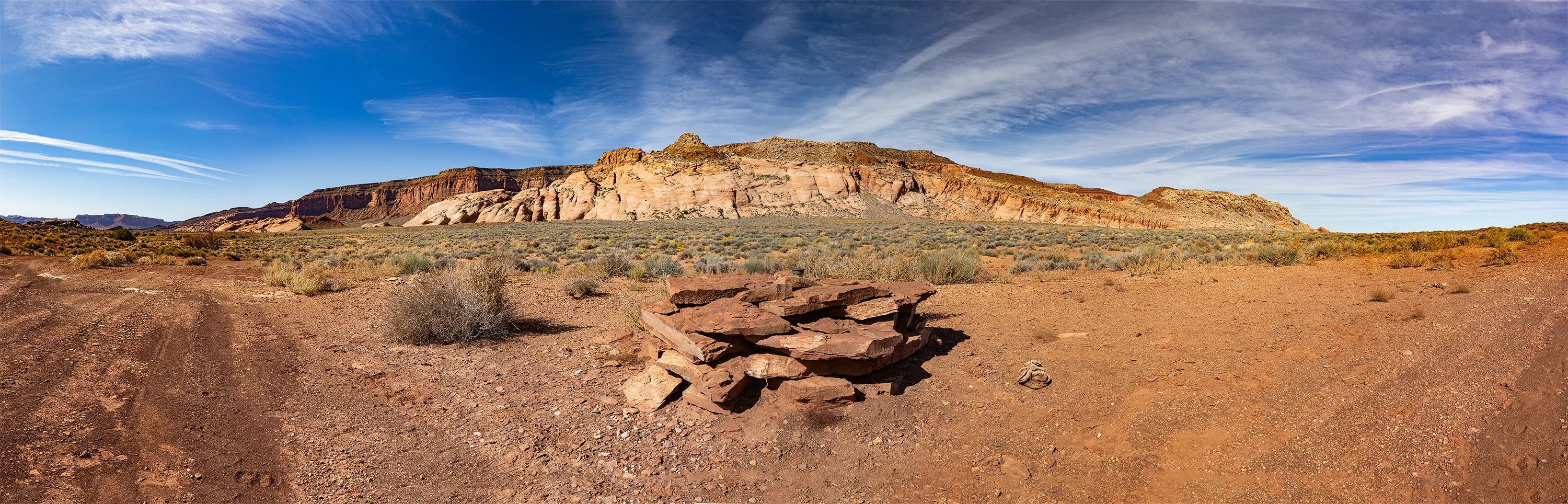
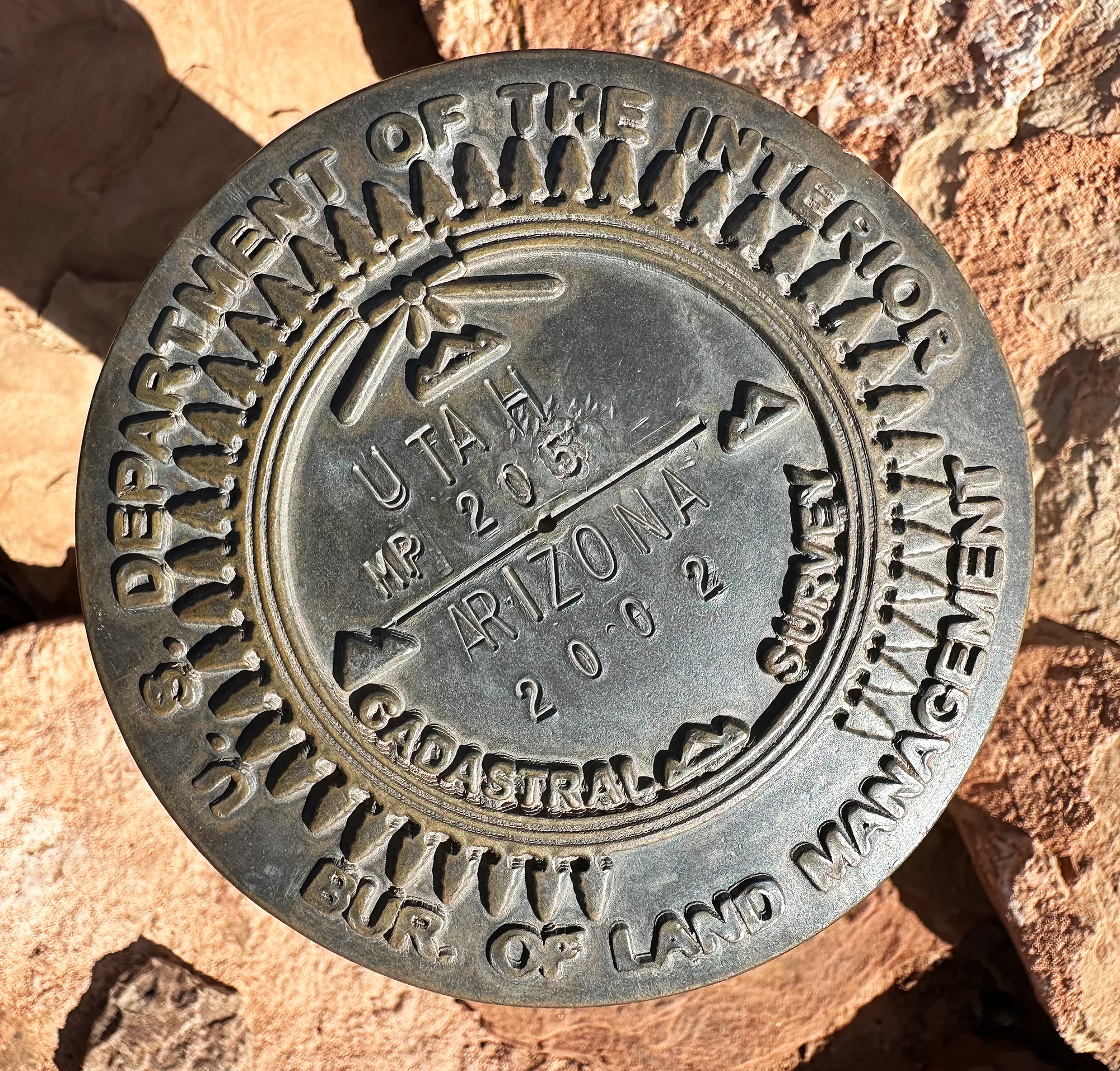
South of Oljato, Utah, past cattle and sheep pens, we met a Navajo rancher who very kindly shepherded us to the Mile 205 monument. He was indifferent to the survey marker, not surprisingly, since it made little difference to his ranching operations. He told a story of a neighbor of his who gave up his pastime of destroying BLM markers only after the Feds showed up and threatened him with jailtime. One suspects the mistrust of the BLM has a long history. Fences have been a touchy subject at least since the 1930s. “Fences can act as borders or barriers and erect themselves as the physical entrapment of imagined or created places,” says Kelsey Davis John (herself a Diné)1.
Government fencing still reminds people of the Navajo Livestock Reduction program of the 1930s. William Zeh, a Navajo forester, had submitted a report documenting overgrazing problems in 1930, and John Collier, the commissioner of what is now called the Bureau of Indian Affairs began instituting a livestock buy-back program in 1934. Although Tribal Chairman Tom Dodge agreed that livestock overpopulation was accelerating erosion, the Navajo Nation bitterly opposed federal intervention, and the buy-back program failed to make a sufficient dent in livestock numbers.
But another drama pushed Collier to take more draconian steps. Rex Tugwell, a member of the Roosevelt Brain Trust, worried that silt from the San Juan and Little Colorado Rivers, which flowed through Navajo land, would silt up Lake Mead behind the brand-new Boulder Dam (soon to be renamed for Hoover). Tugwell told Collier, “[T]he Government ought not to do anything looking toward permanence on the Navajo reservation; ought not to spend money looking to the future unless it could convince itself that erosion was going to be checked.” Historian Peter Iverson concluded: “There is no other word than blackmail for this approach.”2 Collier made the livestock reduction mandatory, and animals were left slaughtered on the land, creating an economic and cultural catastrophe; the feds had no idea how important the animals were, not just economically but culturally. In the end livestock numbers were reduced, but resentment hardened; the program was called the Second Long March, referring, of course, to the horrific expulsion of the Diné from their homeland in 1863. In the end, Collier’s livestock reduction program succeeded mostly in instilling permanent suspicion and resentment of all federal initiatives for decades to come. Collier had begun his career with successfully advocating for the repeal of the Allotment Act, for establishing self rule for all Indigenous nations and promoting respect and dignity for Indigenous nations, but he’s remembered for the imposition of livestock reduction from paternalistic, authoritarian Washington overlords. In the end, Lake Mead did not silt up3, underscoring the tragedy of the whole episode.
Footnotes
(1) Kelsey Dayle John, Fences Tell a Story of Land Changes on the Navajo Nation. https://edgeeffects.net/fences-the-navajo-nation/ JULY 14, 2020
(2) Peter Iverson, Diné — A History of the Navajos (Albuquerque: UNM Press, 2002), p. 148
(3) J. David Rogers, “Hoover Dam: Scientific Studies, Name Controversy, Tourist Attraction, and Contributions to Engineering.” https://web.mst.edu/~rogersda/hoover_dam/Rogers-HooverDam-Pt5.pdf. “Detailed studies of sediment accumulation were undertaken at Lake Mead as soon as the dam’s diversion tunnels were shut down on February 1, 1935. Despite warnings from several prominent engineers that sediment accumulation could endanger the economic models used to justify megaprojects like Hoover Dam (Stevens, 1946), the storage capacity of Lake Mead was reduced by about 5% through sediment accumulation during the first 14 years of operation (1935-49).”